Thakur Publication Pvt.Ltd.
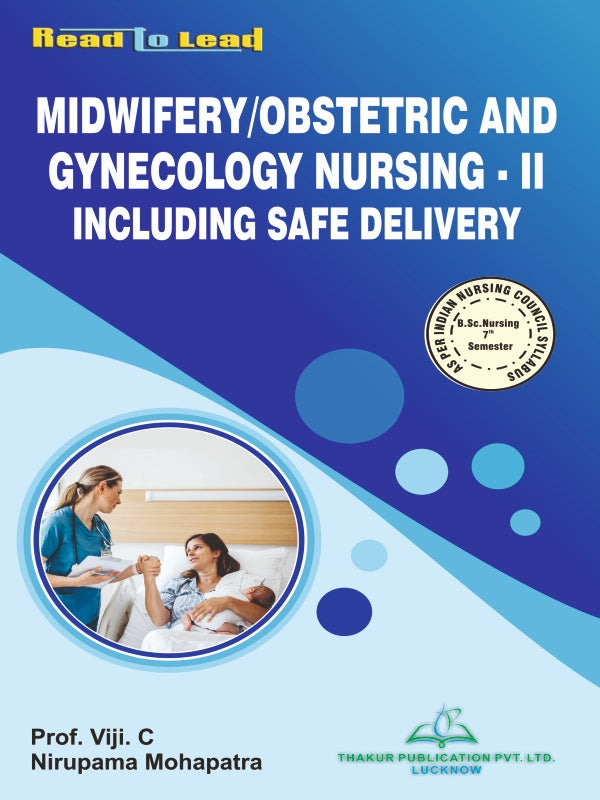
MIDWIFERY/OBSTETRIC AND GYNECOLOGY NURSING-II INCLUDING SAFE DELIERY
MIDWIFERY/OBSTETRIC AND GYNECOLOGY NURSING-II INCLUDING SAFE DELIERY
Couldn't load pickup availability
Midwifery/Obstetric and Gynecology Nursing – II
Syllabus
Midwifery/Obstetric and Gynecology Nursing – II
|
Unit |
Topic |
Hours |
|
I |
Recognition and Management of Problems during Pregnancy · Assessment of high-risk pregnancy, Problems/Complications of Pregnancy · Hyper-emesis gravidarum, · Bleeding in early pregnancy – Abortion, Ectopic pregnancy, Vesicular mole · Unintended or mistimed pregnancy · Post abortion care & counseling · Bleeding in late pregnancy – Placenta previa, Abruption placenta, Trauma · Medical conditions complicating pregnancy – Anemia, PIH/Pre-eclampsia, Eclampsia, GDM, Cardiac disease, Pulmonary disease, Thyrotoxicosis, STDs, HIV, Rh incompatibility · Infections in pregnancy – Urinary tract infection, Bacterial, Viral, Protozoal, Fungal, Malaria in pregnancy · Surgical conditions complicating pregnancy – Appendicitis, Acute abdomen · COVID-19 & pregnancy and children · Hydramnios · Multiple pregnancy · Abnormalities of placenta and cord · Intra uterine growth restriction · Intra uterine fetal death · Gynaecological conditions complicating pregnancy · Mental health issues during pregnancy · Adolescent pregnancy · Elderly primi, Grand multiparity · Management and care of conditions as per the GoI protocol · Policy for the referral services · Drugs used in management of high-risk pregnancies · Maintenance of records and reports |
12(T) 10(L) 80(C) |
|
II |
Recognition and Management of Abnormal Labour · Preterm labour – Prevention and management of preterm labour; (Use of antenatal corticosteroids in preterm labour) · Premature rupture of membranes · Malpositions and abnormal presentations (posterior position, breech, brow, face, shoulder) · Contracted pelvis, Cephalo Pelvic Disproportion (CPD) · Disorders of uterine action – Prolonged labour, Precipitate labour, Dysfunctional labour · Complications of third stage – Retained placenta, Injuries to birth canal, Postpartum hemorrhage (bimanual compression of the uterus, aortic compression, uterine balloon tamponade) · Obstetric emergencies – Foetal distress, Ruptured uterus, Cord prolapse, Shoulder dystocia, Uterine inversion, Vasa previa, Obstetrical shock, Amniotic fluid embolism · Episiotomy and suturing · Obstetric procedures – Forceps delivery, Vacuum delivery, Version · Induction of labour – Medical & Surgical · Caesarean section – Indications and preparation · Nursing management of women undergoing · Obstetric operations and procedures · Drugs used in management of abnormal labour · Anesthesia and analgesia in obstetrics |
20(T) 15(L) 80(C) |
|
III |
Recognition and Management of Postnatal Problems · Physical examination, identification of deviation from normal · Puerperal complications and its management
· Drugs used in abnormal puerperium · Policy about referral |
9(T) 5(L) 40(C) |
|
IV |
Assessment and Management of High Risk Newborn (Review) · Models of newborn care in India –NBCC; SNCUs · Screening of high-risk newborn · Protocols, levels of neonatal care, infection control · Prematurity, Post-maturity · Low birth weight · Kangaroo Mother Care · Birth asphyxia/Hypoxic encephalopathy · Neonatal sepsis · Hypothermia · Respiratory distress · Jaundice · Neonatal infections · High fever · Convulsions · Neonatal tetanus · Congenital anomalies · Baby of HIV positive mothers · Baby of Rh negative mothers · Birth injuries · SIDS (Sudden Infant Death Syndrome) prevention, Compassionate care · Calculation of fluid requirements, EBM/formula feeds/tube feeding · Home based newborn care program – community facility integration in newborn care · Decision making about management and referral · Bereavement counseling · Drugs used for high risk newborns · Maintenance of records and reports |
7(T) 5(L) 40(C) |
|
V |
Assessment and Management of Women with Gynaecological Disorders · Gynaecological assessment – History and Physical assessment · Breast self-examination · Congenital abnormalities of female reproductive system · Etiology, pathophysiology, clinical manifestations, diagnosis, treatment modalities and management of women with:
· Assessment and management of couples with infertility:
· Adoption – counseling, procedures · Injuries and Trauma; Sexual violence · Drugs used in treatment of gynaecological disorders |
12(T) 5(L) 80(C) |
|
Unit 1: Recognition and Management of Problems during Pregnancy |
||
|
1.1. |
High-Risk Pregnancy |
17 |
|
1.1.1. |
Introduction |
17 |
|
1.1.2. |
Risk Factors for High-Risk Pregnancy |
17 |
|
1.1.3. |
Assessment of High-Risk Pregnancy |
17 |
|
1.1.4. |
Management of High-Risk Pregnancy |
18 |
|
1.1.5. |
Prevention of High-Risk Pregnancy |
19 |
|
1.1.6. |
Referral and Follow-up for High Risk Pregnancy |
19 |
|
1.2. |
Problems/Complications of Pregnancy - Hyper-emesis Gravidarum |
19 |
|
1.2.1. |
Introduction |
19 |
|
1.2.2. |
Causes of Nausea and Vomiting in Pregnancy |
19 |
|
1.2.3. |
Signs and Symptoms of Hyperemesis Gravidarum |
20 |
|
1.2.4. |
Complications of Hyperemesis Gravidarum |
20 |
|
1.2.5. |
Diagnosis of Hyperemesis Gravidarum |
20 |
|
1.2.6. |
Management of Hyperemesis Gravidarum |
21 |
|
1.3. |
Bleeding In Early Pregnancy |
22 |
|
1.3.1. |
Introduction |
22 |
|
1.3.2. |
Abortion |
22 |
|
1.3.3. |
Post Abortion Care and Counseling |
28 |
|
1.3.4. |
Ectopic Pregnancy |
31 |
|
1.3.5. |
Vesicular Mole |
35 |
|
1.4. |
Unintended or Mistimed Pregnancy |
38 |
|
1.5. |
Bleeding in Late Pregnancy - Antepartum Haemorrhage |
39 |
|
1.5.1. |
Introduction |
39 |
|
1.5.2. |
Causes of APH |
39 |
|
1.5.3. |
Placenta Previa (Unavoidable Haemorrhage) |
39 |
|
1.5.4. |
Abruptio Placenta (Accidental Haemorrhage) |
43 |
|
1.5.5. |
Trauma in Pregnancy |
47 |
|
1.6. |
Medical Conditions Complicating Pregnancy |
51 |
|
1.6.1. |
Anaemia |
51 |
|
1.6.1.1. |
Iron Deficiency Anaemia |
52 |
|
1.6.1.2. |
Megaloblastic Anaemia |
54 |
|
1.6.1.3. |
Sickle Cell Anaemia |
56 |
|
1.6.2. |
Pregnancy-Induced Hypertension (PIH) |
57 |
|
1.6.2.1. |
Pre-Eclampsia |
58 |
|
1.6.2.2. |
Eclampsia |
61 |
|
1.6.3. |
Gestational Diabetes Mellitus (GDM) |
63 |
|
1.6.4. |
Cardiac Disease |
68 |
|
1.6.5. |
Pulmonary Disease |
71 |
|
1.6.5.1. |
TB (Tuberculosis) |
71 |
|
1.6.5.2. |
Asthma |
73 |
|
1.6.6. |
Thyrotoxicosis |
74 |
|
1.6.7. |
Sexually Transmitted Diseases (STDs ) |
75 |
|
1.6.8. |
Human Immunodeficiency Virus (HIV) |
76 |
|
1.6.9. |
Rh Incompatibility |
82 |
|
1.7. |
Infections In Pregnancy |
84 |
|
1.7.1. |
Bacterial Infection |
84 |
|
1.7.1.1. |
Urinary Tract Infection |
84 |
|
1.7.1.2. |
Tuberculosis (TB) in Pregnancy |
85 |
|
1.7.1.3. |
Bacterial Vaginitis |
85 |
|
1.7.1.4. |
Salpingitis |
86 |
|
1.7.2. |
Viral Infection |
87 |
|
1.7.2.1. |
Toxoplasmosis |
87 |
|
1.7.2.2. |
Other Agents |
87 |
|
1.7.2.3. |
Rubella Virus |
88 |
|
1.7.2.4. |
Cytomegalovirus |
89 |
|
1.7.2.5. |
Herpes Simplex Virus |
89 |
|
1.7.3. |
Protozoal Infection |
90 |
|
1.7.3.1. |
Trichomonas Vaginitis |
90 |
|
1.7.3.2. |
Toxoplasmosis |
91 |
|
1.7.3.3. |
Malaria |
91 |
|
1.7.4. |
Fungal Infection |
92 |
|
1.7.4.1. |
Moniliasis (Candidiasis) |
92 |
|
1.7.4.2. |
Skin Fungal Infections (Tinea) |
94 |
|
1.8. |
Surgical Conditions Complicating Pregnancy - Acute Abdomen Conditions |
94 |
|
1.9. |
Corona Virus Disease (COVID-19) and Pregnancy and Children |
96 |
|
1.10. |
Hydramnios |
99 |
|
1.10.1. |
Introduction |
99 |
|
1.10.2. |
Polyhydramnios |
99 |
|
1.10.3. |
Oligohydramnios |
101 |
|
1.11. |
Multiple Pregnancy |
103 |
|
1.12. |
Abnormalities of Placenta and Cord |
109 |
|
1.12.1. |
Placenta |
109 |
|
1.12.2. |
Umbilical Cord |
111 |
|
1.13. |
Intra Uterine Growth Restriction (IUGR) |
112 |
|
1.14. |
Intra Uterine Foetal Death (IUFD) |
115 |
|
1.15. |
Gynaecological Conditions Complicating Pregnancy |
117 |
|
1.15.1. |
Retroversion and Retroflexion |
117 |
|
1.15.2. |
Uterine Prolapse (Procidentia) |
119 |
|
1.15.3. |
Uterine Malformations |
120 |
|
1.15.4. |
Uterine Fibroids |
121 |
|
1.15.5. |
Ovarian Cysts |
123 |
|
1.15.6. |
Uterine Polyps |
125 |
|
1.15.7. |
Uterine Cancer |
126 |
|
1.16. |
Mental Health Issues During Pregnancy |
128 |
|
1.16.1. |
Introduction |
128 |
|
1.16.2. |
Risk Factors for Mental Disorders |
128 |
|
1.16.3. |
Classification of Mental Disorders |
128 |
|
1.16.3.1. |
Depression |
128 |
|
1.16.3.2. |
Panic Disorder |
129 |
|
1.16.3.3. |
Obsessive-Compulsive Disorder (OCD) |
129 |
|
1.16.3.4. |
Bipolar Mood Disorder |
130 |
|
1.16.3.5. |
Schizophrenia |
130 |
|
1.17. |
Adolescent Pregnancy |
130 |
|
1.18. |
Elderly Primi Gravida |
132 |
|
1.19. |
Grand Multiparity |
134 |
|
1.20. |
Management and Care of Conditions as per the GoI Protocol |
135 |
|
1.21. |
Policy for the Referral Services |
136 |
|
1.22. |
Drugs Used In Management of High-Risk Pregnancies |
136 |
|
1.22.1. |
Drugs Used to Treat Hyperemesis Gravidarum |
136 |
|
1.22.2. |
Drugs used to Treat Ectopic Pregnancy |
137 |
|
1.22.3. |
Drugs used to Treat GDM |
138 |
|
1.22.4. |
Uterotonics |
138 |
|
1.22.4.1. |
Oxytocin |
138 |
|
1.22.4.2. |
Ergot Alkaloids |
139 |
|
1.22.4.3. |
Prostaglandins |
140 |
|
1.22.5. |
Tocolytics |
141 |
|
1.22.6. |
Antihypertensives |
142 |
|
1.22.7. |
Anticonvulsants |
145 |
|
1.22.8. |
Anticoagulants |
146 |
|
1.22.9. |
Diuretics |
146 |
|
1.22.10. |
Analgesia and Anaesthesia |
148 |
|
1.23. |
Maintenance of Records and Reports |
152 |
|
1.24. |
Exercise |
154 |
|
|
|
|
|
Unit 2: Recognition and Management of Abnormal Labour |
||
|
2.1. |
Preterm Labour |
159 |
|
2.2. |
Premature Rupture Of Membranes (PROM) |
163 |
|
2.3. |
Malposition and Abnormal Presentations |
167 |
|
2.3.1. |
Introduction |
167 |
|
2.3.2. |
Causes of Malposition and Abnormal Presentations |
167 |
|
2.3.3. |
Risk Factors of Malposition and Abnormal Presentations |
167 |
|
2.3.4. |
Signs and Symptoms of Malposition and Abnormal Presentations |
167 |
|
2.3.5. |
Complications of Malposition and Abnormal Presentations |
168 |
|
2.3.6. |
Diagnosis of Malposition and Abnormal Presentations |
168 |
|
2.3.7. |
Management of Malposition and Abnormal Presentations |
168 |
|
2.3.8. |
Types of Malposition and Abnormal Presentations |
168 |
|
2.3.8.1. |
Occipito-Posterior (OP) Position |
168 |
|
2.3.8.2. |
Breech Presentation |
172 |
|
2.3.8.3. |
Brow Presentation |
177 |
|
2.3.8.4. |
Face Presentation |
179 |
|
2.3.8.5. |
Shoulder Presentation |
181 |
|
2.3.8.6. |
Compound Presentation |
183 |
|
2.3.8.7. |
Transverse Lie |
183 |
|
2.4. |
Contracted Pelvis |
185 |
|
2.5. |
Cephalo Pelvic Disproportion (CPD) |
191 |
|
2.6. |
Disorders of Uterine Action |
193 |
|
2.6.1. |
Introduction |
193 |
|
2.6.2. |
Causes of Disorders of Uterine Action |
193 |
|
2.6.3. |
Classification of Disorders of Uterine Action |
193 |
|
2.6.4. |
Hypotonic Uterine Action - Uterine Inertia |
193 |
|
2.6.5. |
Hypertonic or Uncoordinated Uterine Action |
195 |
|
2.6.5.1. |
Spastic Lower Uterine Segment |
195 |
|
2.6.5.2. |
Colicky Uterus |
196 |
|
2.6.5.3. |
Constriction or Contraction Ring |
196 |
|
2.6.5.4. |
Uterine Tetany or Generalised Tonic Contraction |
197 |
|
2.6.5.5. |
Cervical Dystocia |
198 |
|
2.6.6. |
Precipitate or Rapid Labour |
198 |
|
2.6.7. |
Bandl’s or Pathological Retraction Ring |
201 |
|
2.7. |
Prolonged Labour |
202 |
|
2.8. |
Dysfunctional Labour |
205 |
|
2.9. |
Complications of Third Stage |
206 |
|
2.9.1. |
Retained Placenta |
206 |
|
2.9.2. |
Injuries to Birth Canal |
209 |
|
2.9.2.1. |
Injuries to Vulva |
209 |
|
2.9.2.2. |
Pelvic Hematomas |
211 |
|
2.9.2.3. |
Visceral Injuries |
212 |
|
2.9.3. |
Postpartum Haemorrhage (PPH) |
213 |
|
2.10. |
Obstetric Emergencies |
220 |
|
2.10.1. |
Introduction |
220 |
|
2.10.2. |
Foetal Distress |
220 |
|
2.10.3. |
Ruptured Uterus |
221 |
|
2.10.4. |
Cord Prolapse |
224 |
|
2.10.5. |
Shoulder Dystocia |
228 |
|
2.10.6. |
Uterine Inversion |
231 |
|
2.10.7. |
Vasa Previa |
234 |
|
2.10.8. |
Obstetrical Shock |
237 |
|
2.10.9. |
Amniotic Fluid Embolism (AFE) |
240 |
|
2.11. |
Episiotomy and Suturing |
242 |
|
2.11.1. |
Introduction |
242 |
|
2.11.2. |
Indications of Episiotomy |
242 |
|
2.11.3. |
Process of Episiotomy |
242 |
|
2.11.4. |
Types of Episiotomy |
243 |
|
2.11.5. |
Degrees of Episiotomy |
243 |
|
2.11.6. |
Complications of Episiotomy |
243 |
|
2.11.7. |
Benefits of Episiotomy |
244 |
|
2.11.8. |
Episiotomy Suturing |
244 |
|
2.12. |
Obstetric Procedures |
245 |
|
2.12.1. |
Forceps Delivery |
245 |
|
2.12.2. |
Vacuum Delivery (Vacuum Extraction) |
250 |
|
2.12.3. |
Version |
254 |
|
2.12.3.1. |
External Cephalic Version (ECV) |
254 |
|
2.12.3.2. |
Internal Podalic Version |
255 |
|
2.12.3.3. |
Bipolar Podalic Version |
256 |
|
2.12.3.4. |
Nursing Management of Women Undergoing Version |
257 |
|
2.13. |
Induction of Labour (IOL) |
257 |
|
2.13.1. |
Introduction |
257 |
|
2.13.2. |
Indications for Induction of Labour |
257 |
|
2.13.3. |
Contraindications of Induction of Labour |
258 |
|
2.13.4. |
Complications of Induction of Labour |
258 |
|
2.13.5. |
Methods for Induction of Labour |
258 |
|
2.13.6. |
Nursing Management of Women Undergoing Induction of Labour |
262 |
|
2.14. |
Caesarean Section |
262 |
|
2.14.1. |
Introduction |
262 |
|
2.14.2. |
Indications for Caesarean Section |
263 |
|
2.14.3. |
Contraindications of Caesarean Section |
263 |
|
2.14.4. |
Types of Caesarean Section |
263 |
|
2.14.5. |
Preparation of the Mother for Caesarean Section |
265 |
|
2.14.6. |
Procedure of Caesarean Section |
266 |
|
2.14.7. |
Complications of Caesarean Section |
270 |
|
2.14.8. |
Nursing Management of Women Undergoing Caesarean Section |
271 |
|
2.15. |
Drug Used in Management of Abnormal Labour |
273 |
|
2.16. |
Anaesthesia and Analgesia in Obstetric |
273 |
|
2.17. |
Exercise |
273 |
|
|
|
|
|
Unit 3: Recognition and Management of Postnatal Problems |
||
|
3.1. |
Recognition and Management of Postnatal Problems |
277 |
|
3.1.1. |
Physical Examination |
277 |
|
3.1.2. |
Psychosocial Assessment |
278 |
|
3.1.3. |
Identification of Deviation from Normal |
280 |
|
3.2. |
Puerperal Complications and its Management |
281 |
|
3.2.1. |
Introduction |
281 |
|
3.2.2. |
Puerperal Pyrexia |
282 |
|
3.2.3. |
Puerperal Sepsis |
284 |
|
3.2.4. |
Urinary Complications |
287 |
|
3.2.4.1. |
Postpartum Urinary Retention (PUR) |
287 |
|
3.2.4.2. |
Postpartum Urinary Incontinence |
288 |
|
3.2.4.3. |
Postpartum Urinary Tract Infections (UTIs) |
289 |
|
3.2.5. |
Secondary Postpartum Hemorrhage (SPPH) |
289 |
|
3.2.6. |
Vulvar Hematoma |
291 |
|
3.2.7. |
Breast Complications |
292 |
|
3.2.7.1. |
Breast Engorgement |
292 |
|
3.2.7.2. |
Mastitis |
294 |
|
3.2.7.3. |
Breast Abscess |
295 |
|
3.2.7.4. |
Inverted/Flat Nipples |
296 |
|
3.2.7.5. |
Cracked Nipple |
298 |
|
3.2.8. |
Thrombophlebitis |
299 |
|
3.2.9. |
Deep Vein Thrombosis (DVT) |
300 |
|
3.2.10. |
Uterine Sub Involution |
302 |
|
3.2.11. |
Vesico-Vaginal Fistula (VVF) |
304 |
|
3.2.12. |
Rectovaginal Fistula (RVF) |
305 |
|
3.2.13. |
Postpartum Depression (Baby Blues) |
306 |
|
3.2.14. |
Puerperal Psychosis |
307 |
|
3.3. |
Drugs Used in Abnormal Puerperium |
308 |
|
3.3.1. |
Uterotonics |
308 |
|
3.3.2. |
Antibiotics |
310 |
|
3.3.3. |
Anticoagulants |
311 |
|
3.3.4. |
Lactation Suppressant - Bromocriptine Mesylate |
311 |
|
3.3.5. |
Antipsychotics/Anti-depressants |
312 |
|
3.4. |
Policy about Referral |
312 |
|
3.5. |
Exercise |
312 |
|
|
|
|
|
Unit 4: Assessment and Management of High Risk Newborn |
||
|
4.1. |
Models of Newborn Care in India |
315 |
|
4.1.1. |
Introduction |
315 |
|
4.1.2. |
New-born Care Corner (NBCC) |
315 |
|
4.1.3. |
Special New-born Care Unit (SNCU) |
316 |
|
4.2. |
Screening of High-Risk Newborn |
319 |
|
4.2.1. |
Introduction |
319 |
|
4.2.2. |
Apgar Scoring |
319 |
|
4.2.3. |
Assessment of Vital Signs |
320 |
|
4.2.4. |
Physical Assessment |
321 |
|
4.2.5. |
Assessment of New-Born for Gestation Age |
325 |
|
4.3. |
Protocols, Levels of Neonatal Care and Infection Control |
330 |
|
4.4. |
Prematurity |
334 |
|
4.5. |
Post-Maturity |
338 |
|
4.6. |
Low Birth Weight |
339 |
|
4.7. |
Kangaroo Mother Care (KMC) |
341 |
|
4.8. |
Birth Asphyxia (Asphyxia Neonatorum) |
343 |
|
4.9. |
Hypoxic Encephalopathy |
347 |
|
4.10. |
Neonatal Sepsis |
349 |
|
4.11. |
Hypothermia |
351 |
|
4.12. |
Respiratory Distress |
356 |
|
4.13. |
Jaundice |
358 |
|
4.14. |
Neonatal Infections |
363 |
|
4.15. |
High Fever (Hyperthermia) |
366 |
|
4.16. |
Convulsions |
368 |
|
4.17. |
Neonatal Tetanus |
371 |
|
4.18. |
Congenital Anomalies |
372 |
|
4.19. |
Baby of HIV Positive Mothers |
377 |
|
4.20. |
Baby of Rh Negative Mothers |
378 |
|
4.21. |
Birth Injuries |
379 |
|
4.21.1. |
Introduction |
379 |
|
4.21.2. |
Types of Birth Injuries |
379 |
|
4.21.3. |
Caput Succedaneum |
379 |
|
4.21.4. |
Cephalohematoma |
380 |
|
4.21.5. |
Facial Palsy/Bell’s Palsy |
382 |
|
4.21.6. |
Erb’s Palsy |
384 |
|
4.21.7. |
Torticollis |
385 |
|
4.21.8. |
Intracranial Haemorrhage |
387 |
|
4.21.9. |
Intraventricular Haemorrhage |
389 |
|
4.22. |
SIDS (Sudden Infant Death Syndrome) |
390 |
|
4.23. |
Calculation of Fluid Requirements |
393 |
|
4.24. |
EBM (Expressing Breast Milk) |
394 |
|
4.25. |
Formula Feeds for Neonates |
396 |
|
4.25.1. |
Introduction |
396 |
|
4.25.2. |
Reasons for Giving Formula Feed |
396 |
|
4.25.3. |
Types of Formula Feed |
396 |
|
4.25.4. |
Preparation of Formula Feed |
397 |
|
4.25.5. |
Schedule of Formula Feeding |
399 |
|
4.26. |
Tube Feeding or Ryle’s Tube Feeding |
400 |
|
4.27. |
Home Based Newborn Care Program |
403 |
|
4.28. |
Decision Making about Management and Referral |
404 |
|
4.29. |
Bereavement Counseling |
406 |
|
4.30. |
Drugs Used for High Risk Newborns |
407 |
|
4.31. |
Maintenance of Records and Reports |
409 |
|
4.32. |
Exercise |
410 |
|
|
|
|
|
Unit 5: Assessment and Management of Women with Gynecological Disorders |
||
|
5.1. |
Gynaecological Assessment |
414 |
|
5.1.1. |
Introduction |
414 |
|
5.1.2. |
History |
414 |
|
5.1.3. |
Physical Assessment |
419 |
|
5.2. |
Congenital Abnormalities of Female Reproductive System |
424 |
|
5.2.1. |
Introduction |
424 |
|
5.2.2. |
Types of Congenital Abnormalities of Female Reproductive System |
424 |
|
5.2.3. |
Etiology of Congenital Abnormalities of Female Reproductive System |
425 |
|
5.2.4. |
Clinical Manifestations of Congenital Abnormalities of Female Reproductive System |
425 |
|
5.2.5. |
Diagnosis of Congenital Abnormalities of Female Reproductive System |
425 |
|
5.2.6. |
Treatment of Congenital Abnormalities of Female Reproductive System |
425 |
|
5.3. |
Menstrual Abnormalities |
426 |
|
5.3.1. |
Introduction |
426 |
|
5.3.2. |
Amenorrhoea |
426 |
|
5.3.3. |
Dysmenorrhoea |
428 |
|
5.3.4. |
Menorrhagia |
430 |
|
5.3.5. |
Premenstrual Syndrome (PMS) |
432 |
|
5.3.6. |
Cryptomenorrhoea |
434 |
|
5.3.7. |
Abnormal Uterine Bleeding (AUB) |
435 |
|
5.4. |
Pelvic Inflammatory Disease (PID) |
437 |
|
5.5. |
Infections of the Reproductive Tract |
440 |
|
5.5.1. |
Vulvitis |
440 |
|
5.5.2. |
Bartholinitis |
441 |
|
5.5.3. |
Vaginitis |
443 |
|
5.5.4. |
Trichomoniasis |
444 |
|
5.5.5. |
Candidiasis |
445 |
|
5.5.6. |
Metritis |
447 |
|
5.5.7. |
Salpingitis |
448 |
|
5.5.8. |
Oophoritis |
449 |
|
5.6. |
Uterine Displacement (Uterine Prolapse) |
450 |
|
5.7. |
Endometriosis |
452 |
|
5.8. |
Uterine Fibroids |
455 |
|
5.9. |
Cervical Fibroids |
458 |
|
5.10. |
Uterine Polyps |
460 |
|
5.11. |
Cervical Polyps |
461 |
|
5.12. |
Tumours |
462 |
|
5.12.1. |
Uterine Tumours (Uterine Cancer) |
462 |
|
5.12.2. |
Cervical Tumours (Cervical Cancer) |
465 |
|
5.12.3. |
Ovarian Tumours (Ovarian Cancer) |
469 |
|
5.12.4. |
Vaginal Tumours (Vaginal Cancer) |
472 |
|
5.12.5. |
Vulvar Tumours (Vulvar Cancer) |
475 |
|
5.13. |
Cysts |
478 |
|
5.13.1. |
Introduction |
478 |
|
5.13.2. |
Ovarian Cysts |
478 |
|
5.13.3. |
Vulvar Cysts |
480 |
|
5.14. |
Cystocele (Prolapsed Bladder) |
482 |
|
5.15. |
Urethrocele (Urethral Prolapse) |
483 |
|
5.16. |
Rectocele (Posterior Vaginal Wall Prolapse) |
485 |
|
5.17. |
Genito-Urinary Fistulas |
486 |
|
5.17.1. |
Vesicovaginal Fistula (VVF) |
487 |
|
5.17.2. |
Urethrovaginal Fistula |
487 |
|
5.17.3. |
Ureterovaginal Fistula |
487 |
|
5.17.4. |
Rectovaginal Fistula (RVF) |
488 |
|
5.18. |
Breast Disorders |
488 |
|
5.18.1. |
Introduction |
488 |
|
5.18.2. |
Mastitis |
489 |
|
5.18.3. |
Breast Abscess |
489 |
|
5.18.4. |
Deformities - Tubular Breasts |
489 |
|
5.18.5. |
Benign Tumours of the Breast |
490 |
|
5.18.6. |
Malignant Tumours of the Breast (Breast Cancer) |
491 |
|
5.19. |
HPV Vaccination |
498 |
|
5.19.1. |
Introduction |
498 |
|
5.19.2. |
HPV Vaccines |
498 |
|
5.19.3. |
Indications of HPV Vaccines |
499 |
|
5.19.4. |
Contraindications of HPV Vaccines |
499 |
|
5.19.5. |
HPV Vaccination Schedule |
499 |
|
5.19.6. |
Side Effects of getting the HPV Vaccine |
500 |
|
5.20. |
Disorders of Puberty |
500 |
|
5.20.1. |
Introduction |
500 |
|
5.20.2. |
Precocious Puberty |
500 |
|
5.20.3. |
Delayed Puberty |
502 |
|
5.21. |
Menopause |
503 |
|
5.21.1. |
Introduction |
503 |
|
5.21.2. |
Physiological Changes |
504 |
|
5.21.3. |
Clinical Manifestations |
505 |
|
5.21.4. |
Diagnosis |
506 |
|
5.21.5. |
Treatment Modalities and Management |
506 |
|
5.22. |
Hormone Replacement Therapy |
506 |
|
5.23. |
Assessment and Management of Couples with Infertility |
508 |
|
5.23.1. |
Infertility |
508 |
|
5.23.2. |
Artificial Reproductive Techniques (ART) |
516 |
|
5.24. |
Surrogacy |
518 |
|
5.25. |
Sperm Donation |
520 |
|
5.26. |
Ovum or Egg Donation |
521 |
|
5.27. |
Cryopreservation |
522 |
|
5.27.1. |
Introduction |
522 |
|
5.27.2. |
Principles of Cryopreservation |
522 |
|
5.27.3. |
Steps in Cryopreservation |
523 |
|
5.27.4. |
Applications of Cryopreservation |
524 |
|
5.27.5. |
Advantages of Cryopreservation |
525 |
|
5.27.6. |
Disadvantage of Cryopreservation |
525 |
|
5.28. |
Adoption |
525 |
|
5.28.1. |
Definitions |
525 |
|
5.28.2. |
Adoption in India |
525 |
|
5.28.3. |
Principles to Govern the Adoption Process in India |
526 |
|
5.28.4. |
Procedure of Adoption in India |
526 |
|
5.28.5. |
Adoption Coordinating Agency |
527 |
|
5.28.6. |
Counseling |
527 |
|
5.28.6.1. |
Pre-Adoption Counseling of PAPs |
528 |
|
5.28.6.2. |
Post-Adoption Counseling |
528 |
|
5.29. |
Genital Injuries |
529 |
|
5.30. |
Genital Trauma |
530 |
|
5.31. |
Sexual Violence |
531 |
|
5.32. |
Drugs Used in Treatment of Gynaecological Disorders |
534 |
|
5.33. |
Exercise |
535 |
Share
