Thakur Publication Pvt.Ltd.
General Pharmacy Book | B.Pharm First Semester | Latest syllabus 2026 | Thakur publication | Hardbound Book
General Pharmacy Book | B.Pharm First Semester | Latest syllabus 2026 | Thakur publication | Hardbound Book
Couldn't load pickup availability
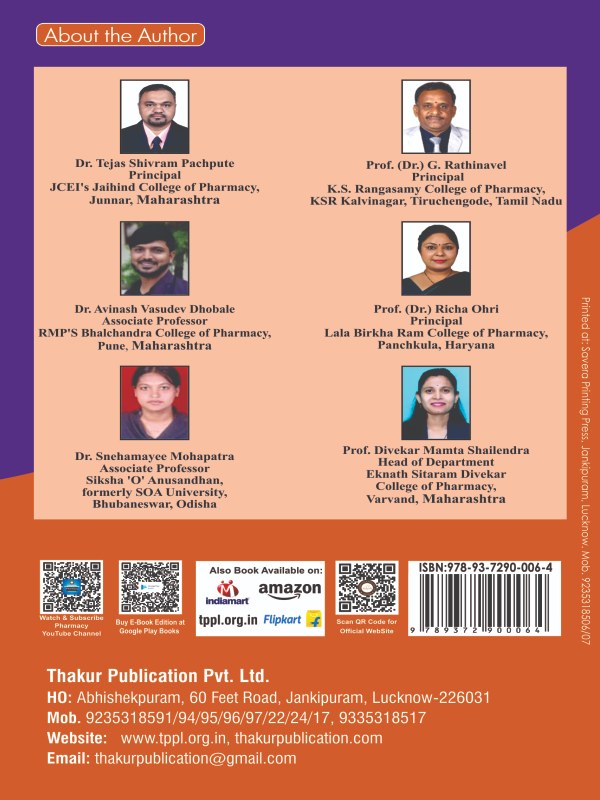
Authors : Dr. Tejas Shivram Pachpute, Prof. (Dr.) G. Rathinavel, Dr. Avinash Vashudev Dhobale, Prof. (Dr.) Richa Ohari, Dr. Snehamayee Mohpatra, Prof. Divekar Mamata Shailendra
ISBN : 9789372900064
Syllabus
BP102T: General Pharmacy (Theory)
|
Unit No.
|
Topics
|
No. of Lectures
|
|
I
|
Introduction to the Profession of Pharmacy
· History of the Profession of Pharmacy in India: In relation to pharmacy education, pharmaceutical industries and organizations – evolution, development and milestones.
· Scope of the Pharmacy Profession: Role and responsibilities of pharmacists in retail/community pharmacy, hospital and clinical pharmacy, and industrial pharmacy including research and development.
· Pharmacopoeias: Introduction to IP, BP, USP, BPC, International Pharmacopoeia, other pharmacopoeias and the National Formulary of India; structure and content of the Indian Pharmacopoeia; study of one model IP monograph.
· Introduction to Prescription: Structure and format/parts of prescription, handling of prescriptions, Latin terminology related to prescriptions.
|
9 Hours
|
|
II
|
Pharmaceutical Calculations
· Metric system of weights and measures; calculations based on alligation, proof spirit, isotonic solutions, dilute solutions (percentage and ratio) and geometric dilution; scientific notation of units and measures.
· Posology: Definition and dose calculation based on age, body weight and body surface area.
· Introduction to Dosage Forms: Routes of administration and classification of dosage forms.
· Introduction to Active Pharmaceutical Ingredients and Excipients: Definition, ideal characteristics and importance.
|
9 Hours
|
|
III
|
Solid Dosage Forms
· Powders: Classification, advantages and disadvantages; dusting powders, effervescent powders, efflorescent powders, hygroscopic powders and eutectic mixtures; introduction to excipients and methods of preparation.
· Tablets: Definition, types of tablets including moulded tablets and pills with examples; advantages and disadvantages; introduction to excipients and methods of preparation.
· Capsules: Definition, types of capsules, advantages and disadvantages, capsule sizes; introduction to excipients and methods of preparation.
|
9 Hours
|
|
IV
|
Monophasic and Biphasic Liquids
· For Internal Use: Aromatic waters, syrups, elixirs and linctus (definition and preparation).
· For External Use and Body Cavities: Liniments, lotions, throat paints, applications, gargles, mouthwashes, enemas, eye drops, ear drops, nasal drops and tinctures with examples.
· Study of official preparations; introduction to excipients and methods of preparation.
· Suspensions: Definition and types (flocculated and deflocculated), advantages and disadvantages, formulation excipients and general methods of preparation.
· Emulsions: Definition and types, emulsifying agents, tests for identification of types of emulsions, formulation excipients and general methods of preparation.
|
9 Hours
|
|
V
|
Semisolid Dosage Forms
· Definitions, classification, advantages and disadvantages, ointment bases and other excipients used in semisolid dosage forms; general methods of preparation of ointments, pastes, creams and gels.
· Suppositories/Pessaries: Definition, types of suppositories, advantages and disadvantages, formulation excipients used in suppositories, properties of ideal suppository bases, types of suppository bases, displacement value and general method of preparation.
|
9 Hours
|
BP107P: General Pharmacy (Practical)
1. Pharmaceutical Calculations
Solutions based on allegation and dilution methods
2. Solutions
a) Strong solution of ammonium acetate – IP
b) Cresol with soap solution – IP
c) Lugol’s solution – BPC
d) Syrups - Simple Syrup – IP
3. Powders & Granules
|
a) ORS powder – WHO
|
b) Effervescent granules – IP
|
|
c) Dusting powder – IP
|
d) Divided powders – IP
|
4. Suppositories
a) Glycero-gelatin suppository – BPC
b) Cocoa butter suppository – IP
c) Zinc Oxide suppository – IP
5. Semisolids
a) Sulphur ointment – IP
b) Non-staining iodine ointment with methyl salicylate – BPC
6. Gargles & Mouthwashes
|
a) Iodine gargle – BPC
|
b) Chlorhexidine mouthwash – IP
|
Note:
a) Preparation of compendia of dosage forms (marketed products), is recommended.
b) Any other practical relevant to the syllabus can be introduced.
c) Minimum 12 experiments must be performed covering all dosage forms.
Share