Thakur Publication Pvt.Ltd.
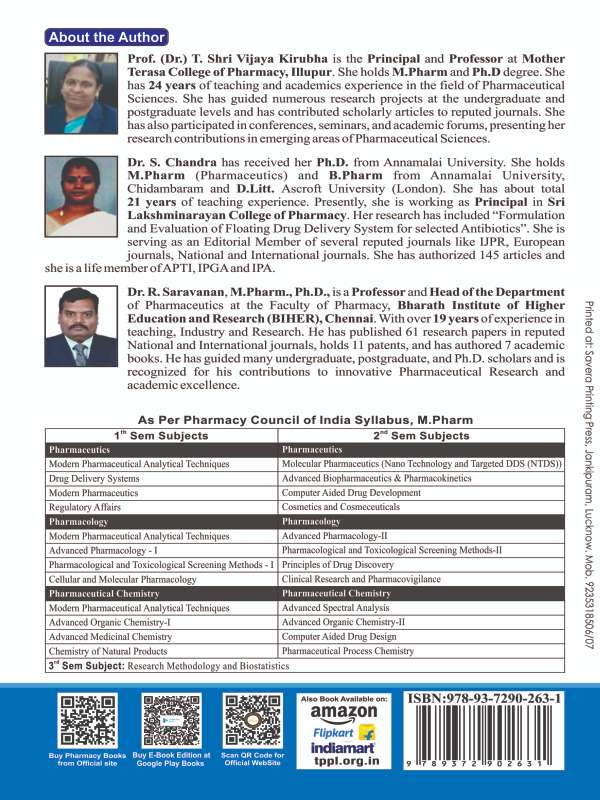
Cosmetics and Cosmeceuticals (Pharmaceutics) M.Pharm Second Semester
Cosmetics and Cosmeceuticals (Pharmaceutics) M.Pharm Second Semester
Couldn't load pickup availability
Syllabus
MPH 204T
Cosmetics and Cosmeceuticals
Theory (60 Hours)
Unit-1 (12 hours)
Cosmetics – Regulatory : Definition of cosmetic products as per Indian regulation. Indian regulatory requirements for labeling of cosmetics. Regulatory provisions relating to import of cosmetics., Misbranded and spurious cosmetics. Regulatory provisions relating to manufacture of cosmetics – Conditions for obtaining license, prohibition of manufacture and sale of certain cosmetics, loan license, offences and penalties.
Unit-2 (12 hours)
Cosmetics - Biological Aspects: Structure of skin relating to problems like dry skin, acne, pigmentation, prickly heat, wrinkles and body odor. Structure of hair and hair growth cycle. Common problems associated with oral cavity. Cleansing and care needs for face, eye lids, lips, hands, feet, nail, scalp, neck, body and under-arm.
Unit-3 (12 hours)
Formulation Building Blocks: Building blocks for different product formulations of cosmetics/cosmeceuticals. Surfactants – Classification and application. Emollients, Rheological additives: classification and application. Antimicrobial used as preservatives, their merits and demerits. Factors affecting microbial preservative efficacy. Building blocks for formulation of a moisturizing cream, vanishing cream, cold cream, shampoo and toothpaste. Soaps and syndetbars. Perfumes: Classification of perfumes. Perfume ingredients listed as allergens in EU regulation. Controversial ingredients: Parabens, formaldehyde liberators, dioxane.
Unit-4 (12 hours)
Design of Cosmeceutical Products: Sun protection, sunscreens classification and regulatory aspects. Addressing dry skin, acne, sun-protection, pigmentation, prickly heat, wrinkles, body odor, dandruff, dental cavities, bleeding gums, mouth odor, and sensitive teeth through cosmeceutical formulations.
Unit-5 (12 hours)
Herbal Cosmetics: Herbal ingredients used in hair care, skin care and oral care. Review of guidelines for herbal cosmetics by private bodies, like COSMOS with respect to preservatives, emollients, foaming agents, emulsifiers and rheology modifiers. Challenges in formulating herbal cosmetics.
Contents
|
|
Unit I Chapter 1: Cosmetics - Regulatory Aspects |
|
|
1.1. |
Cosmetics - Regulatory Aspects |
13 |
|
1.1.1. |
Introduction and Definition of Cosmetic Products as per Indian and EU Regulation |
13 |
|
1.1.2. |
Ideal Properties of Cosmetics |
14 |
|
1.1.3. |
Classification of Cosmetics |
14 |
|
1.1.4. |
Cosmeceuticals |
17 |
|
1.2. |
Cosmetics Regulation as per Drug and Cosmetic Act |
21 |
|
1.3. |
Indian Regulatory Requirements for Labeling of Cosmetics |
22 |
|
1.3.1. |
Packaging of Cosmetics |
22 |
|
1.3.2. |
Labeling Regulations |
24 |
|
1.4. |
Regulatory Provisions Relating to Import of Cosmetics |
27 |
|
1.4.1. |
Introduction |
27 |
|
1.4.2. |
Purpose of Registration |
28 |
|
1.4.3. |
Registration Procedure |
28 |
|
1.4.4. |
Grant of Import Registration Certificate |
29 |
|
1.4.5. |
Validity of Import Registration Certificate |
30 |
|
1.4.6. |
Procedure for Import of Cosmetic Products |
32 |
|
1.4.7. |
Adulterated, Misbranded and Spurious Cosmetics |
36 |
|
1.5. |
Regulatory Provisions Relating to Manufacture of Cosmetics |
38 |
|
1.5.1. |
Introduction |
38 |
|
1.5.2. |
Application for Grant of License |
38 |
|
1.5.3. |
Conditions for Obtaining License |
40 |
|
1.5.4. |
Loan License |
42 |
|
1.5.5. |
Requirements for Factory Layout |
45 |
|
1.5.6. |
Prohibition of Manufacture and Sale of Certain Cosmetics |
53 |
|
1.5.7. |
Offences and Penalties |
55 |
|
1.6. |
Exercise |
56 |
|
|
Unit II Chapter 2: Cosmetics - Biological Aspects |
|
|
2.1. |
Skin |
60 |
|
2.1.1. |
Introduction |
60 |
|
2.1.2. |
Structure of Skin |
60 |
|
2.1.3. |
Functions of Skin |
62 |
|
2.2. |
Common Problems Related to Skin |
63 |
|
2.2.1. |
Introduction |
63 |
|
2.2.2. |
Physiological Consideration of Skin in Relation to Cosmetic Applications |
63 |
|
2.2.3. |
Types of Skin |
64 |
|
2.2.4. |
Dry Skin |
65 |
|
2.2.4.1. |
Pathophysiology of Dry Skin |
66 |
|
2.2.4.2. |
Causes of Dry Skin |
66 |
|
2.2.4.3. |
Symptoms of Dry Skin |
68 |
|
2.2.4.4. |
Treatment of Dry Skin |
68 |
|
2.2.5. |
Contact Dermatitis |
69 |
|
2.2.5.1. |
Causes of Contact Dermatitis |
70 |
|
2.2.5.2. |
Symptoms of Contact Dermatitis |
70 |
|
2.2.5.3. |
Tests for Contact Dermatitis |
70 |
|
2.2.5.4. |
Prevention of Contact Dermatitis |
71 |
|
2.2.5.5. |
Treatment of Contact Dermatitis |
71 |
|
2.2.6. |
Acne |
71 |
|
2.2.6.1. |
Pathophysiology of Acne |
71 |
|
2.2.6.2. |
Types of Acne |
72 |
|
2.2.6.3. |
Causes of Acne |
72 |
|
2.2.6.4. |
Treatment of Acne |
72 |
|
2.2.7. |
Pigmentation |
74 |
|
2.2.7.1. |
Hyperpigmentation |
74 |
|
2.2.7.2. |
Hypopigmentation |
75 |
|
2.2.7.3. |
Treatment of Pigmentation |
75 |
|
2.2.8. |
Prickly Heat |
76 |
|
2.2.8.1. |
Pathophysiology of Prickly Heat |
76 |
|
2.2.8.2. |
Types of Prickly Heat |
76 |
|
2.2.8.3. |
Causes of Prickly Heat |
76 |
|
2.2.8.4. |
Symptoms of Prickly Heat |
77 |
|
2.2.8.5. |
Treatment of Prickly Heat |
77 |
|
2.2.9. |
Wrinkles |
77 |
|
2.2.9.1. |
Pathophysiology of Wrinkles |
78 |
|
2.2.9.2. |
Causes of Wrinkles |
78 |
|
2.2.9.3. |
Symptoms of Wrinkles |
79 |
|
2.2.9.4. |
Treatment of Wrinkles |
80 |
|
2.2.10. |
Body Odour |
81 |
|
2.2.10.1. |
Pathophysiology of Body Odour |
81 |
|
2.2.10.2. |
Causes of Body Odour |
81 |
|
2.2.10.3. |
Symptoms of Body Odour |
82 |
|
2.2.10.4. |
Prevention and Treatment of Body Odour |
82 |
|
2.3. |
Hair |
82 |
|
2.3.1. |
Introduction |
82 |
|
2.3.2. |
Structure of Hair |
83 |
|
2.3.3. |
Functions of Hair |
85 |
|
2.3.4. |
Hair Growth Cycle |
86 |
|
2.3.5. |
Common Problems Related to Hair |
87 |
|
2.4. |
Common Problems Associated with Oral Cavity |
88 |
|
2.5. |
Cleansing and Care Needs for Different Body Parts |
90 |
|
2.5.1. |
Introduction |
90 |
|
2.5.2. |
Cleansing and Care Needs for Face |
90 |
|
2.5.3. |
Cleansing and Care Needs for Eye Lids |
92 |
|
2.5.4. |
Cleansing and Care Needs For Lips |
94 |
|
2.5.5. |
Cleansing and Care Needs of Hands |
97 |
|
2.5.6. |
Cleansing and Care of Feet |
99 |
|
2.5.7. |
Cleansing and Care Needs for Nail |
101 |
|
2.5.8. |
Cleansing and Care Needs for Scalp |
104 |
|
2.5.9. |
Cleansing and Care Needs for Neck |
107 |
|
2.5.10. |
Cleansing and Care Needs for Body |
108 |
|
2.5.11. |
Cleansing and Care Needs for Under-Arm |
110 |
|
2.6. |
Exercise |
114 |
|
|
Unit III Chapter 3: Formulation Building Blocks |
|
|
3.1. |
Building Blocks for Different Product Formulations of Cosmetics/Cosmeceuticals |
118 |
|
3.1.1. |
Introduction |
118 |
|
3.1.2. |
Ideal Properties of Cosmetic Excipients |
118 |
|
3.1.3. |
Examples of Cosmetic Excipients |
119 |
|
3.2. |
Surfactants |
119 |
|
3.2.1. |
Introduction |
119 |
|
3.2.2. |
Classification of Surfactants |
119 |
|
3.2.3. |
Applications of Surfactants |
121 |
|
3.3. |
Emollients |
123 |
|
3.3.1. |
Introduction |
123 |
|
3.3.2. |
Classification of Emollients |
123 |
|
3.3.3. |
Applications of Emollients |
124 |
|
3.4. |
Rheological Additives (Thickeners) |
125 |
|
3.4.1. |
Introduction |
125 |
|
3.4.2. |
Classification of Rheological Additives |
126 |
|
3.4.3. |
Applications of Rheological Additives |
127 |
|
3.5. |
Anti-Microbial Used as Preservatives |
128 |
|
3.5.1. |
Introduction |
128 |
|
3.5.2. |
Ideal Properties of Preservatives |
128 |
|
3.5.3. |
Classification of Preservatives |
129 |
|
3.5.4. |
Parabens |
130 |
|
3.5.5. |
Phenoxyethanol |
131 |
|
3.5.6. |
Benzalkonium Chloride |
132 |
|
3.5.7. |
Chlorhexidine |
133 |
|
3.5.8. |
Factors Affecting Microbial Preservative Efficacy |
134 |
|
3.5.9. |
Merits of Anti-Microbial Preservatives |
135 |
|
3.5.10. |
Demerits of Anti-Microbial Preservatives |
135 |
|
3.6. |
Humectants |
136 |
|
3.6.1. |
Introduction |
136 |
|
3.6.2. |
Ideal Properties of Humectants |
136 |
|
3.6.3. |
Examples of Humectants |
136 |
|
3.6.4. |
Applications of Humectants |
137 |
|
3.7. |
Creams |
138 |
|
3.7.1. |
Introduction |
138 |
|
3.7.2. |
Classification of Creams |
138 |
|
3.7.3. |
Basic Raw Materials used in the Formulation of Creams |
140 |
|
3.8. |
Moisturising Cream |
141 |
|
3.8.1. |
Introduction |
141 |
|
3.8.2. |
Advantages of a Moisturising Cream |
142 |
|
3.8.3. |
Disadvantages of a Moisturising Cream |
142 |
|
3.8.4. |
Role of a Moisturising Cream |
142 |
|
3.8.5. |
Building Blocks for Formulation of a Moisturising Cream |
143 |
|
3.8.6. |
Preparation of a Moisturising Cream |
145 |
|
3.8.7. |
Evaluation of a Moisturising Cream |
146 |
|
3.9. |
Vanishing Cream |
147 |
|
3.9.1. |
Introduction |
147 |
|
3.9.2. |
Advantages of a Vanishing Cream |
147 |
|
3.9.3. |
Disadvantages of a Vanishing Cream |
148 |
|
3.9.4. |
Role of a Vanishing Cream |
148 |
|
3.9.5. |
Building Blocks for Formulation of a Vanishing Cream |
149 |
|
3.9.6. |
Preparation of a Vanishing Cream |
150 |
|
3.9.7. |
Evaluation of a Vanishing Cream |
151 |
|
3.10. |
Cold Cream |
152 |
|
3.10.1. |
Introduction |
152 |
|
3.10.2. |
Advantages of a Cold Cream |
153 |
|
3.10.3. |
Disadvantages of a Cold Cream |
153 |
|
3.10.4. |
Role of a Cold Cream |
154 |
|
3.10.5. |
Building Blocks for Formulation of a Cold Cream |
155 |
|
3.10.6. |
Preparation of a Cold Cream |
155 |
|
3.10.7. |
Evaluation of a Cold Cream |
156 |
|
3.11. |
Shaving Cream |
156 |
|
3.11.1. |
Introduction |
156 |
|
3.11.2. |
Building Blocks for Formulation of a Shaving Cream |
157 |
|
3.11.3. |
Preparation of a Shaving Cream |
158 |
|
3.11.4. |
Evaluation of a Shaving Cream |
159 |
|
3.12. |
Lipstick |
160 |
|
3.12.1. |
Introduction |
160 |
|
3.12.2. |
Building Blocks for Formulation of a Lipstick |
160 |
|
3.12.3. |
Preparation of a Lipstick |
162 |
|
3.12.4. |
Evaluation of a Lipstick |
162 |
|
3.13. |
Shampoo |
165 |
|
3.13.1. |
Introduction |
165 |
|
3.13.2. |
Types of Shampoos |
165 |
|
3.13.3. |
Advantages of a Shampoo |
166 |
|
3.13.4. |
Disadvantages of a Shampoo |
166 |
|
3.13.5. |
Role of a Shampoo |
166 |
|
3.13.6. |
Building Blocks for Formulation of a Shampoo |
167 |
|
3.13.7. |
Preparation of a Shampoo |
168 |
|
3.13.8. |
Evaluation of a Shampoo |
169 |
|
3.14. |
Toothpaste |
169 |
|
3.14.1. |
Introduction |
169 |
|
3.14.2. |
Types of Toothpastes |
170 |
|
3.14.3. |
Advantages of a Toothpaste |
170 |
|
3.14.4. |
Disadvantages of a Toothpaste |
171 |
|
3.14.5. |
Role of a Toothpaste |
171 |
|
3.14.6. |
Building Blocks for Formulation of a Toothpaste |
172 |
|
3.14.7. |
Preparation of a Toothpaste |
173 |
|
3.14.8. |
Evaluation of a Toothpaste |
176 |
|
3.15. |
Soaps and Syndet Bars |
177 |
|
3.15.1. |
Introduction |
177 |
|
3.15.2. |
Types of Soaps |
178 |
|
3.15.3. |
Advantages of Soaps |
178 |
|
3.15.4. |
Disadvantages of Soaps |
179 |
|
3.15.5. |
Role of Soaps |
179 |
|
3.15.6. |
Role of Syndet Bars |
180 |
|
3.15.7. |
Building Blocks for Formulation of Soaps and Syndet Bars |
180 |
|
3.15.8. |
Preparation of Soaps and Syndet Bars |
181 |
|
3.15.9. |
Evaluation of Soaps and Syndet Bars |
182 |
|
3.16. |
Exercise |
183 |
|
|
Chapter 4: Perfumes and Controversial Ingredients |
|
|
4.1. |
Perfumes |
189 |
|
4.1.1. |
Introduction |
189 |
|
4.1.2. |
Classification of Perfumes |
189 |
|
4.1.3. |
Role of Perfumes in Cosmetics |
193 |
|
4.1.4. |
Formulation of Perfumes |
193 |
|
4.1.5. |
Manufacturing of Perfumes |
194 |
|
4.1.6. |
Evaluation of Perfumes |
195 |
|
4.1.7. |
Perfume Ingredients Listed as Allergens in EU Regulation |
195 |
|
4.2. |
Controversial Ingredients |
196 |
|
4.2.1. |
Introduction |
196 |
|
4.2.2. |
Parabens |
197 |
|
4.2.3. |
Formaldehyde Liberators |
198 |
|
4.2.4. |
Dioxane |
200 |
|
4.3. |
Exercise |
201 |
|
|
Unit IV Chapter 5: Design of Cosmeceutical Products |
|
|
5.1. |
Sun Protection |
203 |
|
5.1.1. |
Introduction |
203 |
|
5.1.2. |
Sunscreens |
204 |
|
5.1.3. |
Ideal Properties of Sunscreen Agent |
204 |
|
5.1.4. |
Classification and Mechanism of Action of Sunscreens |
205 |
|
5.1.4.1. |
Topical Sunscreens |
205 |
|
5.1.4.2. |
Systemic Sunscreens |
207 |
|
5.1.5. |
Importance of Sunscreens in Cosmetics |
207 |
|
5.1.6. |
Formulation and Preparation of Sunscreens |
208 |
|
5.1.7. |
Evaluation of Sunscreens |
212 |
|
5.1.8. |
Regulatory Aspects of Sunscreens |
214 |
|
5.2. |
Addressing Dry Skin Through Cosmeceutical Formulations |
216 |
|
5.3. |
Addressing Acne Through Cosmeceutical Formulations |
218 |
|
5.4. |
Addressing Pigmentation Through Cosmeceutical Formulations |
220 |
|
5.5. |
Addressing Wrinkles Through Cosmeceutical Formulations |
224 |
|
5.6. |
Addressing Prickly Heat Through Cosmeceutical Formulations |
225 |
|
5.7. |
Addressing Body Odour Through Cosmeceutical Formulations |
226 |
|
5.7.1. |
Introduction |
226 |
|
5.7.2. |
Deodorants |
227 |
|
5.7.3. |
Anti-Perspirants |
229 |
|
5.8. |
Addressing Dandruff Through Cosmeceutical Formulations |
231 |
|
5.8.1. |
Introduction |
231 |
|
5.8.2. |
Causes of Dandruff |
232 |
|
5.8.3. |
Symptoms of Dandruff |
233 |
|
5.8.4. |
Effects of Dandruff |
233 |
|
5.8.5. |
Treatment of Dandruff |
234 |
|
5.8.6. |
Formulation Components of Anti-Dandruff Shampoo |
235 |
|
5.8.7. |
Method of Preparation of Anti-Dandruff Shampoo |
236 |
|
5.8.8. |
Evaluation of Anti-Dandruff Shampoo |
238 |
|
5.9. |
Hair Colourants or Hair Dyes |
240 |
|
5.9.1. |
Introduction |
240 |
|
5.9.2. |
Types of Hair Dye |
241 |
|
5.9.3. |
Mechanism of Action of Hair Dye |
243 |
|
5.9.4. |
Formulation Components of Hair Dye |
244 |
|
5.9.5. |
Method of Preparation of Hair Dye |
247 |
|
5.9.6. |
Evaluation of Hair Dye |
249 |
|
5.9.7. |
p-Phenylene Diamine (PPD)-based Hair Dye |
249 |
|
5.10. |
Addressing Dental Problems Through Cosmeceutical Formulations |
252 |
|
5.10.1. |
Dental Cavities |
252 |
|
5.10.2. |
Bleeding Gums |
254 |
|
5.10.3. |
Mouth Odour |
256 |
|
5.10.4. |
Sensitive Teeth |
258 |
|
5.10.5. |
Cosmetic Formulations for Dental Problems |
260 |
|
5.11. |
Exercise |
270 |
|
|
Unit V Chapter 6: Herbal Cosmetics |
|
|
6.1. |
Herbal Cosmetics |
274 |
|
6.1.1. |
Introduction |
274 |
|
6.1.2. |
Role of Herbs in Cosmetics |
274 |
|
6.1.3. |
Advantages of Herbal Cosmetics |
275 |
|
6.1.4. |
Disadvantages of Herbal Cosmetics |
275 |
|
6.1.5. |
Scope and New Trends of Herbal Cosmetics |
276 |
|
6.1.6. |
Classification of Herbal Cosmetics |
277 |
|
6.2. |
Herbal Ingredients Used in Hair Care |
278 |
|
6.2.1. |
Introduction |
278 |
|
6.2.2. |
Formulations of Hair Care using Herbal Ingredients |
283 |
|
6.2.2.1. |
Herbal Shampoo |
283 |
|
6.2.2.2. |
Herbal Hair Oil |
286 |
|
6.2.2.3. |
Herbal Hair Colour |
287 |
|
6.2.2.4. |
Herbal Hair Pack |
289 |
|
6.3. |
Herbal Ingredients Used in Skin Care |
290 |
|
6.3.1. |
Introduction |
290 |
|
6.3.2. |
Formulations of Skin Care using Herbal Ingredients |
294 |
|
6.3.2.1. |
Herbal Face Wash |
295 |
|
6.3.2.2. |
Herbal Face Mask |
297 |
|
6.3.2.3. |
Herbal Creams and Lotions |
298 |
|
6.4. |
Herbal Ingredients Used in Oral Care |
299 |
|
6.4.1. |
Introduction |
299 |
|
6.4.2. |
Formulations of Oral Care using Herbal Ingredients |
302 |
|
6.4.2.1. |
Herbal Toothpaste |
302 |
|
6.4.2.2. |
Herbal Mouthwash |
304 |
|
6.5. |
Review of Guidelines for Herbal Cosmetics by COSMOS |
305 |
|
6.5.1. |
Introduction |
305 |
|
6.5.2. |
Origin and Processing of Ingredients |
305 |
|
6.5.3. |
Composition of Total Product |
312 |
|
6.5.4. |
Storage, Manufacturing and Packaging |
314 |
|
6.5.5. |
Environmental Management |
315 |
|
6.5.6. |
Labelling and Communication |
315 |
|
6.5.7. |
Inspection, Certification and Approval |
316 |
|
6.5.8. |
Guidelines by COSMOS with Respect to Preservatives |
319 |
|
6.5.9. |
Guidelines by COSMOS with Respect to Emollients |
321 |
|
6.5.10. |
Guidelines by COSMOS with Respect to Foaming Agents |
324 |
|
6.5.11. |
Guidelines by COSMOS with Respect to Emulsifiers |
327 |
|
6.5.12. |
Guidelines by COSMOS with Respect to Rheology Modifiers |
329 |
|
6.6. |
Challenges in Formulating Herbal Cosmetics |
332 |
|
6.7. |
Exercise |
339 |
Share