Thakur Publication Pvt.Ltd.
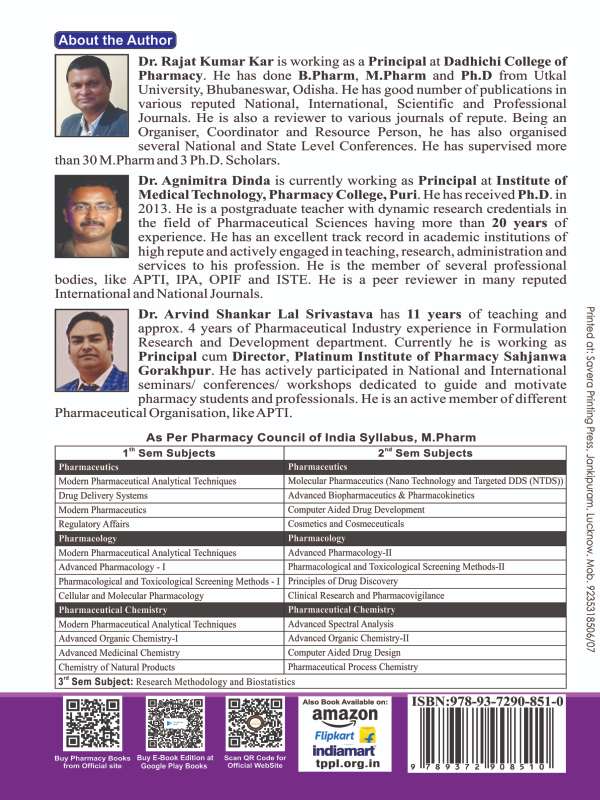
Computer Aided Drug Development (Pharmaceutics First Edition) M.Pharm Second Semester
Computer Aided Drug Development (Pharmaceutics First Edition) M.Pharm Second Semester
Couldn't load pickup availability
Syllabus
MPH 203T
Computer Aided Drug Development
Theory (60 Hours)
Unit-1 (12 hours)
a. Computers in Pharmaceutical Research and Development: A General Overview: History of Computers in Pharmaceutical Research and Development. Statistical modeling in Pharmaceutical research and development: Descriptive versus Mechanistic Modeling, Statistical Parameters, Estimation, Confidence Regions, Nonlinearity at the Optimum, Sensitivity Analysis, Optimal Design, Population Modeling.
b. Quality-by-Design in Pharmaceutical Development: Introduction, ICH Q8 guideline, Regulatory and industry views on QbD, Scientifically based QbD - examples of application.
Unit-2 (12 hours)
Computational Modeling of Drug Disposition: Introduction, Modeling Techniques: Drug Absorption, Solubility, Intestinal Permeation, Drug Distribution, Drug Excretion, Active Transport; P-gp, BCRP, Nucleoside Transporters, hPEPT1, ASBT, OCT, OATP, BBB-Choline Transporter.
Unit-3 (12 hours)
Computer-Aided Formulation Development: Concept of optimization, Optimization parameters, Factorial design, Optimization technology & Screening design. Computers in Pharmaceutical Formulation: Development of pharmaceutical emulsions, microemulsion drug carriers Legal Protection of Innovative Uses of Computers in R&D. The Ethics of Computing in Pharmaceutical Research, Computers in Market analysis.
Unit-4 (12 hours)
a. Computer-Aided Biopharmaceutical Characterization: Gastrointestinal absorption simulation. Introduction, Theoretical background, Model construction, Parameter sensitivity analysis, Virtual trial, Fed vs. fasted state, In vitro dissolution and in vitro in vivo correlation, Biowaiver considerations
b. Computer Simulations in Pharmacokinetics and Pharmacodynamics: Introduction, Computer Simulation: Whole Organism, Isolated Tissues, Organs, Cell, Proteins and Genes.
c. Computers in Clinical Development: Clinical Data Collection and Management, Regulation of Computer Systems.
Unit-5 (12 hours)
Artificial Intelligence (AI), Robotics and Computational Fluid Dynamics: General overview, Pharmaceutical Automation, Pharmaceutical applications, Advantages and Disadvantages, Current Challenges and Future Directions.
Contents
|
Unit-I Chapter 1: Computers in Pharmaceutical Research and Development |
||
|
1.1. |
Computer Aided Drug Development |
15 |
|
1.1.1. |
Introduction |
15 |
|
1.1.2. |
Objectives of Computer-Aided Drug Development |
15 |
|
1.1.3. |
Components of Computer-Aided Drug Development |
15 |
|
1.1.4. |
Applications of Computer-Aided Drug Development |
16 |
|
1.2. |
Computers in Pharmaceutical Research and Development |
17 |
|
1.2.1. |
General Overview |
17 |
|
1.2.2. |
History of Computers in Pharmaceutical Research and Development |
18 |
|
1.2.3. |
Applications of Computers in Pharmaceutical Research and Development |
21 |
|
1.3. |
Statistical Modeling in Pharmaceutical Research and Development |
24 |
|
1.3.1. |
Introduction |
24 |
|
1.3.2. |
History of Statistical Modeling |
25 |
|
1.3.3. |
Objectives of Statistical Modeling |
25 |
|
1.3.4. |
Types of Statistical Modeling |
26 |
|
1.3.5. |
Significance of Statistical Modeling |
28 |
|
1.3.6. |
Applications of Statistical Modeling |
28 |
|
1.4. |
Descriptive versus Mechanistic Modeling |
29 |
|
1.4.1. |
Introduction |
29 |
|
1.4.2. |
Descriptive or Empirical Modeling |
29 |
|
1.4.3. |
Mechanistic Modeling |
30 |
|
1.5. |
Statistical Parameters |
32 |
|
1.5.1. |
Introduction |
32 |
|
1.5.2. |
Types of Statistical Parameters |
32 |
|
1.5.3. |
Data Types in Statistics |
34 |
|
1.5.3.1. |
Qualitative Data (Categorical Data) |
34 |
|
1.5.3.2. |
Quantitative Data (Numerical Data) |
35 |
|
1.5.4. |
Applications of Descriptive Statistics in Pharmaceutical Research and Development |
35 |
|
1.5.5. |
Statistical Parameter Estimation |
36 |
|
1.5.5.1. |
Point Estimation |
36 |
|
1.5.5.2. |
Interval Estimation |
36 |
|
1.5.6. |
Confidence Regions |
37 |
|
1.5.7. |
Non-Linearity at the Optimum |
41 |
|
1.6. |
Sensitivity Analysis |
43 |
|
1.6.1. |
Introduction |
43 |
|
1.6.2. |
Sensitivity Analysis Methods |
44 |
|
1.7. |
Optimal Design |
45 |
|
1.8. |
Population Modeling |
47 |
|
1.8.1. |
Introduction |
47 |
|
1.8.2. |
Rationale for Population Modeling |
48 |
|
1.8.3. |
Population PK/PD Models |
48 |
|
1.8.4. |
Components of Population Models |
49 |
|
1.8.5. |
Benefits of Population Modeling |
50 |
|
1.8.6. |
Challenges and Consideration of Population Modeling |
50 |
|
1.8.7. |
Population versus Non-Population Modeling |
50 |
|
1.9. |
Exercise |
51 |
|
Chapter 2: Quality by Design in Pharmaceutical Development |
||
|
2.1. |
Quality-by-Design (QbD) in Pharmaceutical Development |
54 |
|
2.1.1. |
Introduction |
54 |
|
2.1.2. |
Principles of QbD |
54 |
|
2.1.3. |
Objectives of QbD |
55 |
|
2.1.4. |
Benefits of QbD in Industry and Regulation Bodies |
55 |
|
2.1.5. |
Scope of QbD |
56 |
|
2.1.6. |
Elements of QbD |
57 |
|
2.1.6.1. |
Quality Target Product Profile (QTPP) |
57 |
|
2.1.6.2. |
Critical Quality Attributes (CQAs) |
58 |
|
2.1.6.3. |
Quality Risk Management (QRM) |
59 |
|
2.1.6.4. |
Design Space |
60 |
|
2.1.6.5. |
Control Strategy |
61 |
|
2.1.6.6. |
Life Cycle Management |
62 |
|
2.1.6.7. |
Critical Material Attributes (CMAs) |
63 |
|
2.1.6.8. |
Critical Process Parameters (CPPs) |
63 |
|
2.1.6.9. |
Design of Experiments (DoE) |
65 |
|
2.1.6.10. |
Process Analytical Technology (PAT) |
65 |
|
2.1.7. |
Example of Developing a Pharmaceutical Formulation using QbD |
65 |
|
2.1.8. |
Advantages of QbD |
66 |
|
2.1.9. |
Disadvantages of QbD |
66 |
|
2.1.10. |
Applications of QbD |
67 |
|
2.1.11. |
Comparison between Traditional versus QbD Approach |
68 |
|
2.2. |
ICH Q8 Guideline |
69 |
|
2.2.1. |
Introduction |
69 |
|
2.2.2. |
Objectives of ICH Q8 Guideline |
69 |
|
2.2.3. |
Scope of ICH Q8 Guideline |
70 |
|
2.2.4. |
Pharmaceutical Development |
70 |
|
2.2.4.1. |
Components of the Drug Product (3.2.P.2.1) |
71 |
|
2.2.4.2. |
Drug Product |
72 |
|
2.2.4.3. |
Manufacturing Process Development |
73 |
|
2.2.4.4. |
Container Closure System |
74 |
|
2.2.4.5. |
Microbiological Attributes |
74 |
|
2.2.4.6. |
Compatibility |
75 |
|
2.2.5. |
Role of ICH Q8 Guideline |
75 |
|
2.3. |
ICH Q9 Guideline |
76 |
|
2.4. |
ICH Q10 Guideline |
77 |
|
2.5. |
Regulatory and Industry Views on QbD |
78 |
|
2.5.1. |
Regulatory Views on QbD |
78 |
|
2.5.2. |
Industry Views on QbD |
81 |
|
2.6. |
Scientifically Based QbD |
82 |
|
2.6.1. |
Introduction |
82 |
|
2.6.2. |
Examples of Application of Scientifically-Based QbD |
83 |
|
2.7. |
Exercise |
84 |
|
Unit-II Chapter 3: Computational Modeling of Drug Disposition |
||
|
3.1. |
Computational Modeling of Drug Disposition |
87 |
|
3.1.1. |
Introduction |
87 |
|
3.1.2. |
Need for Computational Modeling in Drug Disposition |
88 |
|
3.1.3. |
Computational Modeling of ADMET |
88 |
|
3.1.4. |
Modeling Techniques |
90 |
|
3.1.4.1. |
Quantitative Modeling |
90 |
|
3.1.4.2. |
Qualitative Modeling |
91 |
|
3.1.4.3. |
Other Significant Modeling Techniques |
92 |
|
3.1.5. |
Applications of Computational Modeling in Drug Development |
93 |
|
3.2. |
Drug Absorption |
93 |
|
3.2.1. |
Introduction |
93 |
|
3.2.2. |
Parameters of Drug Absorption |
93 |
|
3.2.3. |
Computational Modeling Approaches for Drug Absorption |
94 |
|
3.2.4. |
Importance of Modeling Drug Absorption |
96 |
|
3.3. |
Solubility |
96 |
|
3.3.1. |
Introduction |
96 |
|
3.3.2. |
Computational Modeling Approaches for Solubility |
96 |
|
3.3.3. |
Factors Influencing Solubility Modeling |
98 |
|
3.4. |
Intestinal Permeation |
98 |
|
3.4.1. |
Introduction |
98 |
|
3.4.2. |
Computational Modeling Approaches for Intestinal Permeation |
98 |
|
3.5. |
Drug Distribution |
100 |
|
3.5.1. |
Introduction |
100 |
|
3.5.2. |
Volume of Distribution (Vd) |
100 |
|
3.5.3. |
Plasma-Protein Binding (PPB) |
100 |
|
3.5.4. |
Blood-Brain Barrier (BBB) Permeability |
100 |
|
3.5.5. |
Computational Modeling Approaches for Drug Distribution |
101 |
|
3.5.6. |
Factors Influencing Distribution Modeling |
102 |
|
3.6. |
Drug Excretion |
102 |
|
3.6.1. |
Introduction |
102 |
|
3.6.2. |
Computational Modeling Approaches for Drug Excretion |
102 |
|
3.6.3. |
Factors Influencing Excretion Modeling |
104 |
|
3.7. |
Active Transport |
104 |
|
3.7.1. |
Introduction |
104 |
|
3.7.2. |
Transporters |
105 |
|
3.7.3. |
Active Transporters |
105 |
|
3.7.3.1. |
Influx Transporter |
106 |
|
3.7.3.2. |
Efflux Transporter |
107 |
|
3.8. |
P-gp Efflux Transporter |
108 |
|
3.8.1. |
Introduction |
108 |
|
3.8.2. |
Computational Modeling Approaches for P-gp Efflux Transporter |
108 |
|
3.8.3. |
Inhibition of P-gp Efflux Transporter |
109 |
|
3.8.4. |
Role of P-gp Efflux Transporter in Drug Disposition |
109 |
|
3.8.5. |
Role of P-gp Efflux Transporter in Cell Homeostasis and Bioavailability |
110 |
|
3.8.6. |
Role of P-gp Inhibition for Optimal Drug Delivery |
110 |
|
3.9. |
BCRP (Breast Cancer Resistance Protein) Efflux Transporter |
111 |
|
3.9.1. |
Introduction |
111 |
|
3.9.2. |
Computational Modeling Approaches for BCRP Efflux Transporter |
111 |
|
3.9.3. |
Role of BCRP Efflux Transporter in Drug Disposition |
112 |
|
3.10. |
Nucleoside Transporters |
112 |
|
3.10.1. |
Introduction |
112 |
|
3.10.2. |
Types of Nucleoside Transporters |
112 |
|
3.10.3. |
Computational Modeling Approaches for Nucleoside Transporters |
113 |
|
3.10.4. |
Role of Nucleoside Transporters in Drug Disposition |
113 |
|
3.11. |
hPEPT1 (Human Peptide Transporter 1) |
113 |
|
3.11.1. |
Introduction |
113 |
|
3.11.2. |
Computational Modeling Approaches for hPEPT1 |
114 |
|
3.11.3. |
Role of hPEPT1 in Drug Disposition |
114 |
|
3.12. |
ASBT (Apical Sodium-Dependent Bile Acid Transporter) |
114 |
|
3.12.1. |
Introduction |
114 |
|
3.12.2. |
Computational Modeling Approaches for ASBT |
114 |
|
3.12.3. |
Role of ASBT in Drug Disposition |
115 |
|
3.13. |
OCT (Organic Cation Transporters) |
115 |
|
3.13.1. |
Introduction |
115 |
|
3.13.2. |
Computational Modeling Approaches for OCT |
115 |
|
3.13.3. |
Role of OCT in Drug Disposition |
116 |
|
3.14. |
OATP (Organic Anion Transporting Polypeptides) |
116 |
|
3.14.1. |
Introduction |
116 |
|
3.14.2. |
Computational Modeling Approaches for OATP |
117 |
|
3.14.3. |
Role of OATP in Drug Disposition |
117 |
|
3.15. |
BBB-Choline Transporter |
117 |
|
3.15.1. |
Introduction |
117 |
|
3.15.2. |
Computational Modeling Approaches for BBB-Choline Transporter |
118 |
|
3.15.3. |
Role of BBB-Choline Transporter in Drug Disposition |
118 |
|
3.16. |
Exercise |
118 |
|
|
Unit-III Chapter 4: Computer-Aided Formulation Development |
|
|
4.1. |
Computer-Aided Formulation Development |
122 |
|
4.2. |
Concept of Optimization |
123 |
|
4.2.1. |
Introduction |
123 |
|
4.2.2. |
Terms used in Optimisation |
124 |
|
4.2.3. |
Computer Software Used in Optimisation |
128 |
|
4.2.4. |
Objectives/Need of Optimisation |
128 |
|
4.2.5. |
Benefits of Optimisation |
128 |
|
4.2.6. |
Process of Optimisation |
129 |
|
4.2.7. |
Optimization Parameters |
130 |
|
4.2.8. |
Importance of Optimisation in Pharmaceutical Formulation |
132 |
|
4.3. |
Experimental Design/Design of Experiment (DoE) |
133 |
|
4.3.1. |
Introduction |
133 |
|
4.3.2. |
Importance of Experimental Design |
133 |
|
4.3.3. |
Types of Experimental Design |
133 |
|
4.3.4. |
Keys Steps for Experimental Design |
135 |
|
4.3.5. |
Applications of Experimental Design in Pharmaceutical Formulation |
136 |
|
4.4. |
Optimisation Technology |
137 |
|
4.4.1. |
Introduction |
137 |
|
4.4.2. |
Evolutionary Operations |
137 |
|
4.4.3. |
Simplex Method |
138 |
|
4.4.4. |
Lagrangian Method |
138 |
|
4.4.5. |
Search Method |
141 |
|
4.4.6. |
Canonical Analysis |
143 |
|
4.5. |
Screening Design |
143 |
|
4.5.1. |
Introduction |
143 |
|
4.5.2. |
Objectives of Screening Design |
144 |
|
4.5.3. |
Types of Screening Design |
144 |
|
4.5.4. |
Importance of Screening Design |
145 |
|
4.6. |
Factorial Design |
145 |
|
4.6.1. |
Introduction |
145 |
|
4.6.2. |
Key Features of Factorial Design |
146 |
|
4.6.3. |
Types of Factorial Design |
146 |
|
4.6.3.1. |
Full Factorial Design |
146 |
|
4.6.3.2. |
Fractional Factorial Design |
148 |
|
4.6.4. |
Steps Involved in Using Factorial Design |
150 |
|
4.6.5. |
Advantages of Factorial Design |
151 |
|
4.6.6. |
Disadvantages of Factorial Design |
151 |
|
4.6.7. |
Applications of Factorial Design in Formulation |
151 |
|
4.7. |
Response Surface Method (RSM) |
152 |
|
4.7.1. |
Introduction |
152 |
|
4.7.2. |
Objectives of RSM |
152 |
|
4.7.3. |
Key Components of RSM |
153 |
|
4.7.4. |
Steps in Implementing RSM in Pharmaceutical Formulation |
154 |
|
4.7.5. |
Advantages of RSM |
155 |
|
4.7.6. |
Limitations of RSM |
155 |
|
4.7.7. |
Applications of RSM |
155 |
|
4.8. |
Exercise |
156 |
|
|
Chapter 5: Computers in Pharmaceutical Formulation |
|
|
5.1. |
Computers in Pharmaceutical Formulation |
159 |
|
5.1.1. |
Introduction |
159 |
|
5.1.2. |
Role of Computer in Pharmaceutical Formulation |
159 |
|
5.2. |
Development of Pharmaceutical Emulsions |
160 |
|
5.2.1. |
Introduction |
160 |
|
5.2.2. |
Applications of Computer-Aided Techniques in Development of Pharmaceutical Emulsions |
161 |
|
5.2.3. |
Steps in Computer-Aided Development of Pharmaceutical Emulsions |
162 |
|
5.2.4. |
Factorial Design in Development of Emulsion |
164 |
|
5.3. |
Development of Microemulsion Drug Carriers |
166 |
|
5.3.1. |
Introduction |
166 |
|
5.3.2. |
Significance of Computers in the Development of Pharmaceutical Microemulsions |
166 |
|
5.3.3. |
Strategies for Formulation of Microemulsions |
167 |
|
5.3.4. |
Optimisation Designs in the Preparation of Microemulsion |
168 |
|
5.4. |
Legal Protection of Innovative Uses of Computers in R&D |
171 |
|
5.4.1. |
Introduction |
171 |
|
5.4.2. |
Intellectual Property Rights |
171 |
|
5.4.2.1. |
Patents |
173 |
|
5.4.2.2. |
Copyright |
174 |
|
5.4.2.3. |
Database Rights |
175 |
|
5.4.2.4. |
Trade Secret |
175 |
|
5.4.2.5. |
Trademark |
176 |
|
5.4.3. |
Significance of Legal Protection for Computers in Pharmaceutical R&D |
177 |
|
5.5. |
The Ethics of Computing in Pharmaceutical Research |
177 |
|
5.5.1. |
Introduction |
177 |
|
5.5.2. |
Ethical Issues |
178 |
|
5.5.3. |
Codes of Conduct Relevant to the Use of Computer |
180 |
|
5.6. |
Computers in Market Analysis |
181 |
|
5.6.1. |
Introduction |
181 |
|
5.6.2. |
Use of Computers in Market Analysis |
181 |
|
5.6.3. |
Advantages of Computers in Market Analysis |
182 |
|
5.7. |
Exercise |
182 |
|
Unit-IV Chapter 6: Computer-Aided Biopharmaceutical Characterization |
||
|
6.1. |
Computer-Aided Biopharmaceutical Characterization |
185 |
|
6.2. |
Gastrointestinal Absorption Simulation |
187 |
|
6.2.1. |
Introduction |
187 |
|
6.2.2. |
Computational Models for Gastrointestinal Absorption |
187 |
|
6.2.3. |
Mathematical Models for Gastrointestinal Absorption |
188 |
|
6.2.4. |
Parameters for Computer-Aided Gastrointestinal Absorption Simulation |
188 |
|
6.2.5. |
Theoretical Background of Gastrointestinal Absorption Simulation |
189 |
|
6.2.6. |
Importance of Computer-Aided Biopharmaceutical Characterisation for Gastrointestinal Absorption Simulation |
192 |
|
6.2.7. |
Model Construction |
193 |
|
6.2.7.1. |
Process of Model Construction |
193 |
|
6.2.7.2. |
Example of Model Construction |
194 |
|
6.3. |
Parameter Sensitivity Analysis |
198 |
|
6.3.1. |
Introduction |
198 |
|
6.3.2. |
Methods for Parameter Sensitivity Analysis |
198 |
|
6.3.3. |
Example of Parameter Sensitivity Analysis |
199 |
|
6.3.4. |
Importance of Parameter Sensitivity Analysis |
200 |
|
6.4. |
Virtual Trial |
201 |
|
6.4.1. |
Introduction |
201 |
|
6.4.2. |
Example of Virtual Trial |
201 |
|
6.4.3. |
Importance of Virtual Trial |
203 |
|
6.5. |
Fed vs. Fasted State |
204 |
|
6.5.1. |
Introduction |
204 |
|
6.5.2. |
Impact of Fed vs. Fasted State |
204 |
|
6.5.3. |
Gastrointestinal Absorption Simulation for Fed vs. Fasted State |
206 |
|
6.5.4. |
Differences Between Fed vs. Fasted State |
206 |
|
6.6. |
In Vitro Dissolution and In Vitro-In Vivo Correlation |
207 |
|
6.6.1. |
Introduction |
207 |
|
6.6.2. |
In Vitro Dissolution |
207 |
|
6.6.3. |
In Vitro-In Vivo Correlation |
208 |
|
6.6.3.1. |
Purpose of IVIVC |
208 |
|
6.6.3.2. |
Levels of IVIVC |
209 |
|
6.6.3.3. |
Methods of IVIVC (Convolution and Deconvolution) |
211 |
|
6.6.3.4. |
Significance of IVIVC in Biopharmaceutical Characterisation and Pharmaceutical Drug Development |
213 |
|
6.7. |
Biowaiver Considerations |
214 |
|
6.7.1. |
Introduction |
214 |
|
6.7.2. |
BCS-based Biowaivers and its Requirements |
215 |
|
6.7.3. |
Role of Computer Aided Technology Simulation to Justify Biowaiver |
216 |
|
6.7.4. |
Exception for Biowaiver Consideration |
217 |
|
6.8. |
Exercise |
217 |
|
|
Chapter 7: Computer Simulations in Pharmacokinetics and Pharmacodynamics |
|
|
7.1. |
Computer Simulations in Pharmacokinetics and Pharmacodynamics |
220 |
|
7.1.1. |
Introduction |
220 |
|
7.1.2. |
Pharmacokinetics and Pharmacodynamics Simulation |
221 |
|
7.1.3. |
Importance of Computer Simulation in Pharmacokinetics and Pharmacodynamics |
222 |
|
7.2. |
Levels of Computer Simulation |
223 |
|
7.2.1. |
Introduction |
223 |
|
7.2.2. |
Level 1 - Computer Simulation of Whole Organism |
223 |
|
7.2.2.1. |
Lumped-Parameter PK-PD Model |
223 |
|
7.2.2.2. |
Physiological Modeling |
224 |
|
7.2.3. |
Level 2 - Computer Simulation of Isolated Tissues and Organs |
225 |
|
7.2.4. |
Level 3 - Computer Simulation of Cell |
227 |
|
7.2.5. |
Level 4 - Computer Simulation of Proteins and Genes |
228 |
|
7.3. |
Exercise |
229 |
|
|
Chapter 8: Computers in Clinical Development |
|
|
8.1. |
Computers in Clinical Development |
231 |
|
8.1.1. |
Introduction |
231 |
|
8.1.2. |
Significance/Role of Computers in Clinical Data Development |
232 |
|
8.2. |
Clinical Data Collection and Management |
233 |
|
8.2.1. |
Introduction |
233 |
|
8.2.2. |
Data Collection versus Management |
233 |
|
8.2.3. |
Communication in Clinical Data Collection and Management |
234 |
|
8.2.4. |
Methods of Clinical Data Collection |
235 |
|
8.2.4.1. |
Pure Paper-Based Systems |
235 |
|
8.2.4.2. |
Pure Electronic-Based Systems |
236 |
|
8.2.4.3. |
Hybrid Paper-Based Systems |
238 |
|
8.2.5. |
Acquiring Proprietary e-Clinical Software |
239 |
|
8.2.6. |
Integration of Communication |
240 |
|
8.2.6.1. |
Process Before Data Collection |
240 |
|
8.2.6.2. |
Process during Data Collection |
241 |
|
8.2.6.3. |
Process after Data Collection |
242 |
|
8.2.7. |
Clinical Data Management |
243 |
|
8.2.7.1. |
Process of Clinical Data Management |
243 |
|
8.2.7.2. |
Regulation of Clinical Data Management |
244 |
|
8.2.8. |
Role of Computers in Clinical Data Collection and Management |
244 |
|
8.2.9. |
Difficulties in Clinical Data Collection and Management and Use of Computers to Overcome them |
245 |
|
8.3. |
Regulation of Computer Systems |
247 |
|
8.3.1. |
Introduction |
247 |
|
8.3.2. |
CFR Part 11 |
247 |
|
8.4. |
Exercise |
248 |
|
|
Unit-V Chapter 9: Artificial Intelligence, Robotics and Computational Fluid Dynamics |
|
|
9.1. |
Artificial Intelligence (AI) |
250 |
|
9.1.1. |
General Overview |
250 |
|
9.1.2. |
Evolution of Artificial Intelligence (AI) |
250 |
|
9.1.3. |
Advantages of Artificial Intelligence (AI) |
250 |
|
9.1.4. |
Disadvantages of Artificial Intelligence (AI) |
251 |
|
9.1.5. |
Significance of Artificial Intelligence (AI) in Pharmaceutical Industry |
252 |
|
9.1.6. |
Pharmaceutical Applications of Artificial Intelligence (AI) |
252 |
|
9.1.7. |
Challenges in Use of Artificial Intelligence (AI) |
255 |
|
9.1.8. |
Future Directions of Artificial Intelligence (AI) |
257 |
|
9.2. |
Robotics |
258 |
|
9.2.1. |
General Overview |
258 |
|
9.2.2. |
Types of Robots Used in Pharma Industry |
259 |
|
9.2.3. |
Advantages of Robotics |
260 |
|
9.2.4. |
Disadvantages of Robotics |
262 |
|
9.2.5. |
Significance of Robotics in Pharmaceutical Industry |
262 |
|
9.2.6. |
Pharmaceutical Applications of Robotics |
263 |
|
9.2.7. |
Current Challenges in Use of Robotics |
266 |
|
9.2.8. |
Future Directions of Robotics |
266 |
|
9.3. |
Pharmaceutical Automation |
267 |
|
9.3.1. |
General Overview |
267 |
|
9.3.2. |
Advantages of Pharmaceutical Automation |
267 |
|
9.3.3. |
Disadvantages of Pharmaceutical Automation |
268 |
|
9.3.4. |
Significance of Pharmaceutical Automation in Pharmaceutical Industry |
269 |
|
9.3.5. |
Pharmaceutical Applications of Pharmaceutical Automation |
270 |
|
9.3.6. |
Pharmaceutical Automation in Tablet Manufacturing |
274 |
|
9.3.7. |
Current Challenges in Use of Pharmaceutical Automation |
275 |
|
9.3.8. |
Future Directions of Pharmaceutical Automation |
276 |
|
9.4. |
Computational Fluid Dynamics |
276 |
|
9.4.1. |
General Overview |
276 |
|
9.4.2. |
Advantages of Computational Fluid Dynamics |
277 |
|
9.4.3. |
Disadvantages of Computational Fluid Dynamics |
277 |
|
9.4.4. |
Significance of Computational Fluid Dynamics in Pharmaceutical Industry |
278 |
|
9.4.5. |
Pharmaceutical Applications of Computational Fluid Dynamics |
279 |
|
9.4.6. |
Current Challenges in Use of Computational Fluid Dynamics |
280 |
|
9.4.7. |
Future Directions of Computational Fluid Dynamics |
281 |
|
9.5. |
Exercise |
282 |
Share